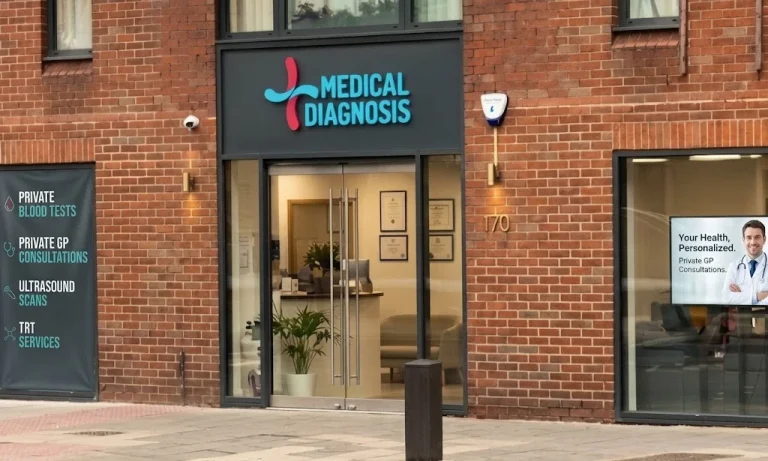


A karyotype test checks the number and structure of your chromosomes. A Y chromosome microdeletion test looks for small missing sections of the Y chromosome that affect sperm production. They find different things, so fertility specialists often request both for men with very low or absent sperm counts. At Medical Diagnosis Victoria (170 Vauxhall Bridge Road, London SW1V 1DX), the karyotype costs £338 and the Y microdeletion test costs £183. A single £26 phlebotomy fee is charged per visit, so both tests together cost £547 from one blood draw.
Prices at a glance
The £26 phlebotomy and genetic test processing fee is charged once per visit, not per test. Whether you book one test or both, you pay the £26 fee only once.
| What you book | Test price | Phlebotomy fee | Total |
|---|---|---|---|
| Karyotype / Chromosome Analysis only | £338 | £26 | £364 |
| Y Chromosome Microdeletion only | £183 | £26 | £209 |
| Both tests at the same visit | £521 | £26 (charged once) | £547 |
Booking both tests at the same appointment saves £26 compared with two separate visits (£573), and you only need one blood draw.
Karyotype vs Y chromosome microdeletion: the key differences
| Karyotype / Chromosome Analysis | Y Chromosome Microdeletion | |
|---|---|---|
| What it examines | Number and visible structure of all chromosomes | AZFa, AZFb and AZFc regions of the Y chromosome |
| What it can find | Extra or missing chromosomes, translocations, inversions, larger deletions or duplications, 47,XXY (Klinefelter syndrome) | Microdeletions in genes needed for sperm production |
| Laboratory method | G-banded chromosome analysis, 20 metaphases (30 if mosaicism is suspected) | Multiplex PCR of sequence-tagged sites (STSs) |
| Sample | Blood | Blood |
| Turnaround | 4 to 6 weeks | About 15 days from sample receipt |
| Price | £338 | £183 |
| Can it replace the other test? | No | No |
A karyotype looks at whole chromosomes under a microscope. A Y microdeletion test finds missing sections of DNA that are too small to see on a standard karyotype. A normal karyotype does not rule out a Y chromosome microdeletion, and a normal Y microdeletion result does not rule out a chromosome abnormality. That is why the two tests are often requested together.
What is a karyotype (chromosome analysis) test?
A karyotype test, also called chromosome analysis, examines the number and visible structure of chromosomes in your cells. Most human cells contain 46 chromosomes arranged in 23 pairs. Changes in chromosome number, or larger structural changes, can contribute to infertility, recurrent pregnancy loss and some genetic conditions.
At Medical Diagnosis Victoria, the laboratory uses G-banding, a staining technique that produces light and dark bands along each chromosome. Cells are examined at metaphase, the stage of cell division when chromosomes are visible, and arranged into a karyogram.
What a karyotype can identify
- Extra or missing chromosomes
- Visible structural rearrangements, such as translocations and inversions
- Larger deletions or duplications
- The 47,XXY pattern associated with Klinefelter syndrome
- Chromosome changes relevant to fertility investigations
Mosaicism
The laboratory routinely analyses 20 metaphases. If mosaicism (a mixture of cells with different chromosome patterns) is suspected, 30 metaphases are analysed to help exclude mosaicism above 10%. If mosaic Klinefelter syndrome or another mosaic condition is suspected, it must be stated in the reason for referral.
Limitations
A conventional karyotype is not a full DNA sequencing test. It may not detect small genetic variants, many single-gene disorders or changes below its resolution. A normal result does not exclude every genetic cause of infertility.
What is a Y chromosome microdeletion test?
The Y chromosome microdeletion test is a targeted molecular genetic blood test. It looks for small missing sections of DNA (microdeletions) in the AZF (Azoospermia Factor) regions: AZFa, AZFb and AZFc. These regions contain genes needed for sperm production (spermatogenesis).
Deletions in these regions can stop sperm production completely (azoospermia) or severely reduce it (severe oligospermia).
How the test works
DNA is extracted from your blood sample. The laboratory uses multiplex PCR to amplify targeted sequence-tagged sites (STSs) across the Y chromosome, then checks whether each genetic marker is present or absent.
What it detects and does not detect
- Assesses complete and partial deletions within the targeted AZFa, AZFb and AZFc regions.
- Not designed to assess specific partial AZFc deletions such as gr/gr or b2/b3. If you need testing for one of these, ask the clinic or your clinician.
Who should consider these tests?
Urologists, andrologists and fertility specialists commonly recommend these tests as part of a male infertility work-up, especially for men with:
- Azoospermia: no sperm found in the semen sample
- Severe oligospermia: a very low sperm count
- Cryptozoospermia: sperm are so scarce they are found only after concentrating the sample
- Upcoming IVF or ICSI: pre-treatment genetic evaluation
- A family history of male infertility or chromosome variations
- Abnormal semen analysis results leading to genetic counselling referral
A karyotype may also be used to investigate recurrent pregnancy loss, suspected chromosome conditions, or a known or suspected chromosome rearrangement in the family.
Why many men have both tests at the same visit
The two tests answer different questions:
- The karyotype checks for problems with whole chromosomes, such as Klinefelter syndrome (47,XXY) or a translocation.
- The Y microdeletion test checks for small missing sections in the Y chromosome that a karyotype cannot see.
Together they cover the two most common genetic causes of severe male infertility. At Medical Diagnosis Victoria, both can be collected from one blood draw at the same appointment, and the £26 phlebotomy fee is charged only once, giving a total of £547.
Results arrive separately: the Y microdeletion report usually comes in about 15 days, and the karyotype report in 4 to 6 weeks.
How to book and what to expect
- Book directly – no GP or consultation needed
Direct booking is available. You do not need a separate doctor consultation before booking the karyotype test, and the Y microdeletion test page does not state that a referral is required. If your fertility clinic has its own testing requirements, check them before your appointment.
- Choose the right day
Genetic blood samples are only accepted on:
Monday – throughout the day
Tuesday – before 12:00 PM (Tuesday is the preferred day)
Samples cannot be accepted on Wednesday to Sunday for genetic tests. For the karyotype test, the clinic asks patients to arrive at Patient Reception by 12:00 PM at the latest on Monday or Tuesday, so arriving on a Monday or Tuesday morning is the safest choice if you are booking both tests. - Call to confirm
Call the clinic to confirm your appointment and collection availability before travelling.
- Give a blood sample
Both tests use a single blood sample. No fasting or other preparation is listed for either test.
Step 5: Receive your report
| Test | Expected turnaround |
|---|---|
| Y Chromosome Microdeletion | About 15 days from sample receipt |
| Karyotype / Chromosome Analysis | 4 to 6 weeks |
You receive a laboratory report that you can share with your fertility clinic.
Understanding your results
Karyotype results
The report uses standard cytogenetic notation, for example:
- 46,XY – a typical male chromosome complement
- 47,XXY – an extra X chromosome, associated with Klinefelter syndrome
A normal result means no reportable chromosome change was found within the test’s detection limits. An abnormal result should be discussed with a clinician or genetics specialist.
Y chromosome microdeletion results
The report states “Detected” or “Not Detected” for the tested AZFa, AZFb and AZFc regions.
- Not Detected: no microdeletions found in the targeted regions.
- Detected: a deletion was found in one or more regions. What it means depends on the region involved.
Can men with a Y microdeletion have biological children?
Some men with an AZFc deletion still produce some sperm, which may allow sperm retrieval and assisted reproduction such as ICSI. Outcomes vary and cannot be guaranteed.
Can a Y microdeletion be passed on?
Yes. A Y chromosome is passed from father to son, so a microdeletion may be passed to sons conceived using the father’s sperm, including through IVF or ICSI. Genetic counselling is strongly recommended.
All results should be reviewed by a qualified clinician alongside your medical history, examination and semen analysis.
Frequently asked questions
At Medical Diagnosis Victoria, the karyotype test costs £338 plus a £26 phlebotomy fee per visit, totalling £364.
The Y chromosome microdeletion test costs £183 plus a £26 phlebotomy fee per visit, totalling £209.
£547. The phlebotomy fee is charged once per visit, not per test, so booking both tests at the same appointment means you pay £338 + £183 + £26.
No. The £26 phlebotomy and genetic test processing fee is charged once per visit, whether you book one test or several compatible blood tests.
A karyotype examines whole chromosomes under a microscope for numerical and large structural changes, such as Klinefelter syndrome. A Y microdeletion test is a molecular test that finds small missing sections of the Y chromosome that are too small to see on a karyotype.
No separate doctor consultation is needed to book the karyotype test, and the Y microdeletion page does not state that a referral is required. Check your fertility clinic’s own requirements.
Mondays throughout the day and Tuesdays before 12:00 PM, with Tuesday preferred. Call the clinic to confirm before attending.
About 15 days for the Y microdeletion test and 4 to 6 weeks for the karyotype.
Yes. A standard karyotype can detect the 47,XXY pattern. If mosaicism is suspected, 30 metaphases are analysed – state this in the reason for referral.
No. The test assesses complete and partial deletions in the targeted AZF regions but is not designed to assess gr/gr or b2/b3 partial AZFc deletions.
No fasting or other preparation is listed for either test.
Yes. You receive a laboratory report that can be shared with your fertility clinic.
Book your genetic fertility tests in London
Medical Diagnosis Victoria
170 Vauxhall Bridge Road, London SW1V 1DX
Telephone: 020 3146 9508 / 020 8830 0503
Email: victoria@medical-diagnosis.co.uk
Opening hours: Monday – Friday 9:00 AM – 5:00 PM, Saturday 9:00 AM – 12:00 PM, Sunday closed
Genetic sample collection: Monday all day, Tuesday before 12:00 PM
- Book the Karyotype / Chromosome Analysis Test | £338 + £26
- Book the Y Chromosome Microdeletion Test | £183 + £26
- Book both at one visit | £547 total
This article provides general information and does not replace personalised medical advice. Results should always be interpreted by a qualified healthcare professional.